Quick Answer: The Main Role of a Clear Epoxy Topcoat
| Selection Factor | Recommended Understanding |
|---|---|
| Primary Use | Cover 3D graphics, metallic-effect layers or other decorative surfaces with a continuous transparent finish |
| Suitable Spaces | Indoor decorative projects where wear requirements can be controlled |
| Main Priorities | Clarity, leveling, substrate compatibility, decorative-layer compatibility, material usage and curing conditions |
| Claims That Should Not Be Assumed | High wear resistance, scratch resistance, vehicle traffic or industrial machinery use |
| Additional Items to Evaluate | Primer, protective layer, slip resistance, wear layer and long-term maintenance |
This type of product is intended primarily for decorative floors where visual appearance is the main value.
Projects involving heavy foot traffic, dragged furniture, sand abrasion or vehicle traffic require a separate evaluation of compatible wear-protection systems.
What Does a Clear Epoxy Topcoat Do in a Flooring System?
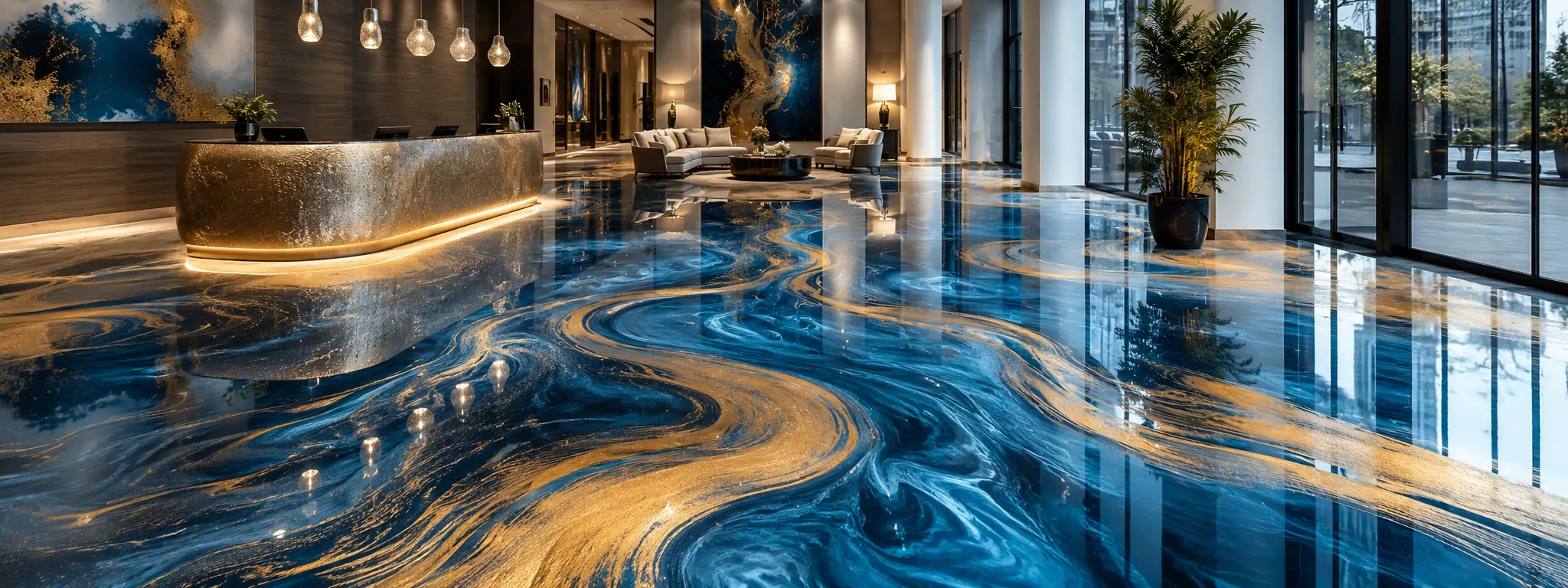
A clear epoxy topcoat sits above the decorative layer, keeps the graphic or metallic pattern visible, and increases visual depth and gloss.
It may sometimes be discussed for an intermediate layer depending on the project, but it should not automatically be used for every layer without testing.
A typical decorative-floor system may include:
- 01Prepared and leveled substrate
- 02Primer or sealing layer
- 033D graphic, metallic effect or another decorative layer
- 04Clear epoxy topcoat
- 05Optional compatible protective layer
How Is Clear Epoxy Used Over 3D Floor Graphics?
Before applying clear epoxy over a printed graphic, confirm the installation condition of the actual graphic material.
- Graphic fully bonded
- No wrinkles
- No raised edges
- No trapped air
- Printing ink or film compatibility
- Substrate dryness, cleanliness and flatness
- Edge thickness variation
- Color, clarity and gloss after testing
A small test panel should use the actual printed graphic material.
Testing only on blank plastic or an empty floor does not confirm compatibility with the real image system.
How Is Clear Epoxy Used Over Metallic Decorative Flooring?
Metallic effects depend on pigments and application technique. The clear topcoat covers and displays the pattern, but it may disturb a decorative layer that has not reached the correct condition.
Sample-panel checks include:
- Overcoating condition of the metallic layer
- Pulling, dissolving or blurring of the pattern
- Pigment and additive compatibility
- Craters, fisheyes, bubbles and waves
- Local loss of gloss
- Visible tool joints and uneven thickness
Metallic patterns should not be described as guaranteed or identical from project to project.
How Should Material Usage and Thickness Be Planned?
Actual consumption depends on floor area, substrate flatness, target layer thickness, material density, application loss, site conditions and operator technique.
Internal reference values include approximately 0.8-1.2 kg/m2 and approximately 1 kg of material forming around 0.9-1.1 mm over 1 m2.
These values should not be presented together as fixed application guarantees until the area basis, density and test conditions have been fully aligned.
Planning principles:
- Use the corresponding TDS and verified application panel
- Measure net floor area
- Allow for substrate unevenness and edge loss
- Do not apply flat-panel consumption to rough or absorbent substrates
- Test a small area before large installation
- Confirm exotherm, leveling and curing before increasing thickness
Performance Limitations of Decorative Clear Epoxy
Decorative clear epoxy topcoat should not be described as a heavy-duty, scratch-resistant and wear-resistant industrial floor.
Increasing the amount of clear epoxy is not a substitute for a proper wear-protection design.
Caution is required for:
- Sand and hard-particle abrasion
- Metal casters
- Repeated furniture dragging
- Equipment or goods dragging
- Vehicle or forklift traffic
- Industrial machinery
- Projects requiring a defined slip rating
- Chemical-resistance requirements
- Heavy-load certification
- Expectations of a permanently scratch-free mirror finish
What Information Should Be Provided for Purchasing and Sample Testing?
| Information Required | Buyer Should Provide |
|---|---|
| Floor Type | 3D printed graphic, metallic effect, solid-color decorative layer or another system |
| Installation Area | Total area, separated areas, edges and finishing details |
| Substrate | Concrete, existing epoxy or another material, including its preparation condition |
| Use Space | Residence, showroom, shop, office or another indoor environment |
| Wear Conditions | Foot traffic, furniture dragging, sand, equipment or vehicles |
| Installation Conditions | Temperature, humidity, ventilation, tools and planned layer structure |
| Current Problem | Bubbles, craters, adhesion, leveling, loss of gloss or scratches |
Conclusion
Clear epoxy topcoat is mainly for visual clarity, leveling and decorative coverage. It is not primarily a heavy-duty wear surface.
Substrate condition, layer compatibility, consumption and wear conditions must be checked before a larger installation.
Higher wear, scratch, slip or industrial-load requirements need an additional verified system.
Frequently Asked Questions
It should not be assumed. The substrate condition, primer or sealing layer, moisture condition, adhesion and surface preparation should be confirmed before applying a clear topcoat.
It may be evaluated for both decorative systems, but printed graphics and metallic pigment layers have different compatibility risks. Each system should be tested with the actual decorative layer.
No. Increasing thickness may affect leveling, heat buildup, curing and material consumption. Thickness should be based on the selected system, substrate and sample-panel results.
The current product is not primarily positioned for scratch resistance or wear resistance. Projects requiring higher wear protection should evaluate a compatible protective wear layer or another verified system.
It should not be positioned as a heavy-duty factory, vehicle or parking-area floor. Those applications require separate evaluation of abrasion, load, slip and chemical-resistance requirements.
NEXT STEP
Need Help Planning a Clear Decorative Floor Topcoat?
Share the decorative-layer type, substrate, installation area, use environment and expected wear conditions. Our team can help identify a suitable resin direction and sample-panel plan.
Explore 3D Art Flooring Solutions