Quick Selection Guide
A practical selection process is:
- Finished product
- Required cured character
- Production priority
- Suitable formula direction
- Sample testing
- Soft or medium-soft epoxy for labels and stickers requiring flexibility.
- Medium-hard or hard epoxy for rigid badges, nameplates and relief products.
- Faster-surface-dry hard formulas when production cycle is a priority.
- PU doming resin when stronger outdoor yellowing and UV resistance are required.
Choose Soft or Hard Doming Resin
Soft and Medium-Soft Epoxy Resin
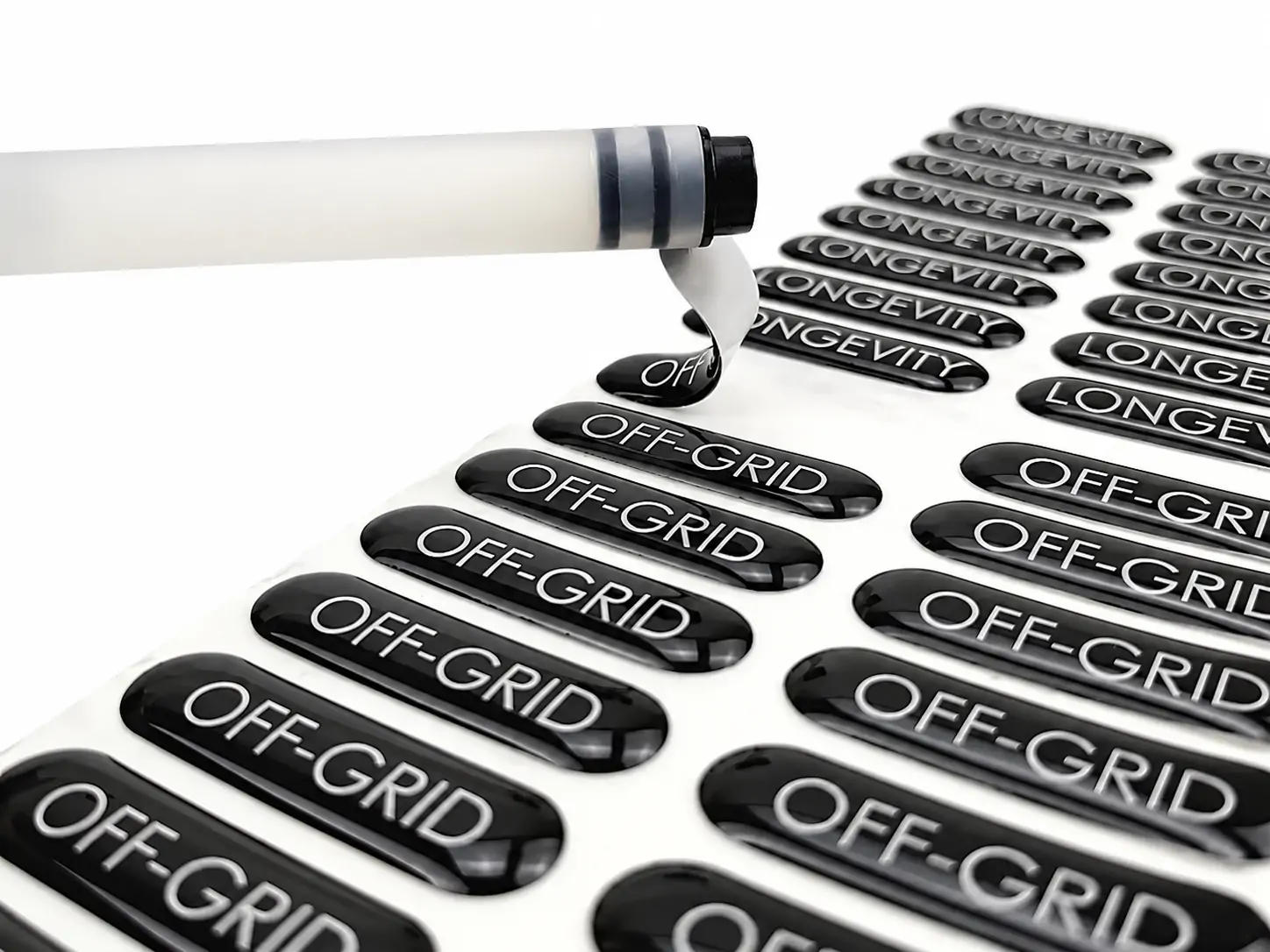
A softer cured layer is usually used for domed labels, flexible 3D stickers, promotional labels and dimensional graphics that may bend slightly.
Main considerations include required flexibility, surface rebound, yellowing-resistance level, cure speed and production cost.
Medium-Hard and Hard Epoxy Resin
A harder cured layer is usually more suitable for rigid badges, nameplates, relief products, rigid decorative labels and dimensional sticker products.
Main considerations include target hardness, shape retention, optical clarity, viscosity and curing cycle.
Harder is not always better. A hard formula may not suit flexible stickers, while an overly soft formula may not meet the forming requirements of badges.
| Selection Factor | Soft / Medium-Soft Epoxy | Medium-Hard / Hard Epoxy |
|---|---|---|
| Cured Character | Flexible or slightly elastic cured layer. | More rigid cured surface with stronger shape retention. |
| Typical Applications | Flexible labels, 3D stickers and promotional labels. | Badges, nameplates, relief products and rigid decorative labels. |
| Shape Retention | Suitable where slight bending or surface rebound is needed. | Suitable where dome height and stable form are priorities. |
| Main Considerations | Flexibility, rebound, yellowing resistance, cure speed and cost. | Hardness, transparency, brittleness, viscosity and curing cycle. |
| Testing Focus | Flexibility, adhesion, edge control and final surface effect. | Hardness, clarity, dome height and finished-product appearance. |
How Should 3:1 and 2:1 Resin Be Understood?
The mixing ratio refers to the correct ratio required for resin curing. It does not independently determine hardness, transparency or cure speed.
3:1 Epoxy Resin Series
The 3:1 epoxy series may include soft, medium-soft, medium-hard and hard formulas. This allows manufacturers to select different cured characters while keeping a familiar production ratio.
2:1 Hard Epoxy Series
For rigid dimensional products requiring a hard cured surface and faster surface-dry performance, a 2:1 formula may be selected.
The correct selection should not be simplified to "3:1 is soft and 2:1 is hard." Some 3:1 formulas are also hard. The complete formula and actual production conditions matter more than the ratio alone.
Select by Finished Product
Domed Labels and 3D Stickers
When the product requires some flexibility, soft or medium-soft epoxy is usually a suitable selection direction. The domed shape, transparency, bubble release, edge control, adhesion, cured flexibility and final surface effect should be evaluated.
Badges and Nameplates
When stronger shape retention and a hard surface are required, medium-hard or hard epoxy may be more suitable. Hardness, transparency, brittleness, dome height and surface effect should be evaluated.
Relief and Dimensional Products
Larger or more rigid products may require higher transparency, stronger shape retention, controlled dispensing volume and a suitable curing cycle. Final selection should be confirmed with the actual product size and substrate.
Production Method Also Matters
Manual Dispensing
Manual production requires accurate A/B weighing, thorough mixing, suitable working time, bubble release and controlled dispensing volume.
Automatic Dispensing
Machine production also requires evaluation of equipment ratio settings, viscosity, metering accuracy, mixing-head performance, resin flow and batch consistency.
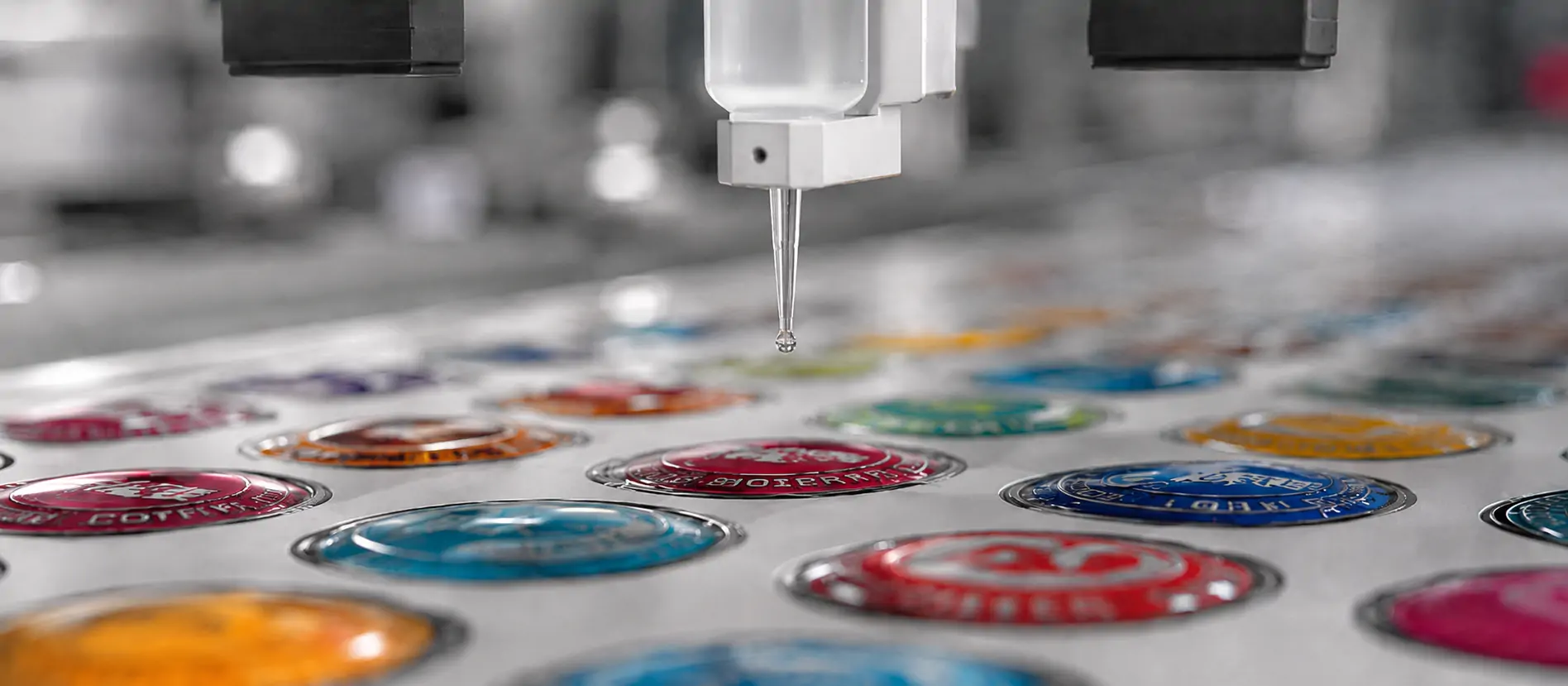
It should not be assumed that one resin is suitable for all dispensing equipment. Compatibility must be tested using the actual equipment and production parameters.
Confirm Substrate Compatibility
Epoxy doming resin may be tested on substrates such as acrylic, metal and selected printed label materials.
Adhesion is also affected by surface cleanliness, printing ink, protective coating, surface treatment and curing temperature. Testing should therefore use the same printed substrate used in production.
When Epoxy Doming Resin Is Not the Right Choice
Outdoor Labels
Standard epoxy doming resin is mainly positioned for indoor applications. For outdoor use cases requiring stronger UV and yellowing-resistance performance, a suitable PU doming resin should be evaluated.
View Outdoor PU Doming Resin Options
River Tables and Deep Pouring
Doming resin is not designed for large-volume or thick-layer casting. River-table resin has different requirements for pour-depth control, exotherm, working time and curing cycle.
3D Art Flooring
Doming resin cannot replace flooring resin systems. Flooring resin has different requirements for application area, coating thickness and substrate preparation.
Small Mold Casting
Mold casting and surface doming are different processes. When resin needs to fill a mold, a dedicated casting resin may be more suitable.
Information to Prepare Before Requesting a Sample
Buyers should provide:
- Finished product type
- Indoor or outdoor use
- Required cured character
- Substrate material
- Manual or automatic dispensing
- Current production problem
- Estimated purchasing quantity
The buyer does not need to know the exact HSFECL formula number. The supplier can recommend an initial formula direction based on the information above.
Explore Doming Resin Solutions View 3:1 / 2:1 Epoxy Doming Resin Request an Epoxy Doming Resin Sample
Conclusion
The correct selection of epoxy doming resin should be based on finished product type and required cured character, not only on mixing ratio.
For indoor labels and 3D stickers, soft or medium-soft epoxy can provide the required flexibility. For badges, nameplates and relief products, medium-hard or hard epoxy can provide better shape retention.
Before bulk purchasing, test the resin using the actual substrate, printed surface, dispensing equipment, curing conditions and finished-product requirements.
Frequently Asked Questions
There is no absolute better option. Soft resin is usually more suitable for flexible labels, while hard resin is more suitable for rigid badges and nameplates.
No. The 3:1 series may include soft, medium-soft, medium-hard and hard formulas.
Standard epoxy doming resin is mainly positioned for indoor applications. When stronger outdoor yellowing resistance is required, PU resin should be considered.
Some formulas may be evaluated for machine dispensing, but compatibility depends on equipment ratio settings, viscosity and the mixing system.
No. Doming resin is used for controlled surface doming, not thick-layer or large-volume casting.
NEXT STEP
Need Help Choosing an Epoxy Doming Formula?
Share your label, sticker, badge or nameplate application and tell us the cured character you need. Our team can recommend a formula direction for sample testing.
Explore Doming Resin Solutions